

Introducing multijob scratch concept
Introducing multijob scratch concept
Does your research run dozens or hundreds of calculations on the same large dataset, such as a reference genome, a chemical database or a text corpus? You no longer need to copy that data in and out for every single job.
With the new multijob scratch, your temporary workspace persists between jobs. Copy your dataset into your own folder once, and all your subsequent jobs can use it right away, for days or even weeks, with no repeated file transfers.
Please note: multijob scratch is still temporary storage, not an archive. Files that are not used for several weeks are deleted automatically, so always move your final results to regular storage.
Choose your variant
- Multijob fast scratch (
multijob=brnoormultijob=plzen): high-speed parallel storage located in Brno or Plzeň, ideal for data-intensive analyses with heavy reading and writing. The Brno storage is known as BeeGFS, which many of you already know; the Plzeň storage is brand new. - Multijob global scratch (
multijob=global): slower network storage (CephFS) that is accessible from every compute node in MetaCentrum. It is a good fit when your jobs mostly read large shared files or pass results from one step to the next.
How to get started
Unlike standard scratch, where the system creates a directory for you automatically, with multijob scratch you create your own project directory once in /scratch/multijob-{brno|plzen|global}/$USER/ and point your jobs to it.
For ready-to-use job scripts and a short guide to picking the right scratch for your work, see our scratch documentation page.
Comparison of MetaCentrum scratch types
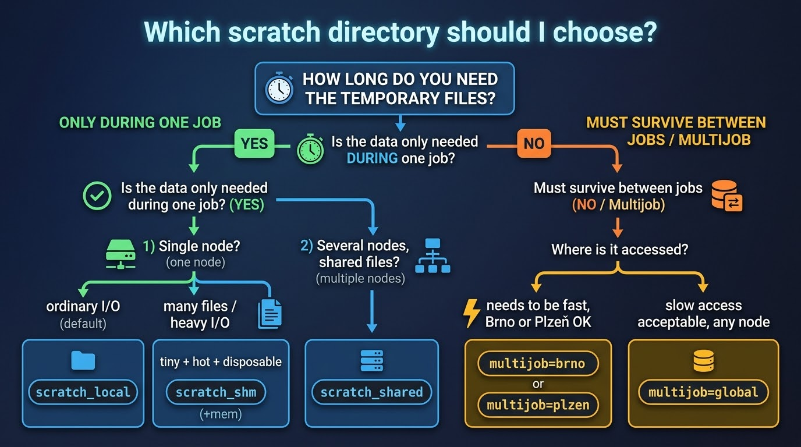
Choosing the right scratch type is one of the most important decisions for job performance. The overview below will help you decide.
| Scratch type | PBS resource | Speed and availability | Lifetime and directory management | Best use and notes |
|---|---|---|---|---|
| Local scratch (default choice) |
scratch_local=10gb |
Moderate (HDD on some nodes); available on every node | Single job (deleted when the job ends); PBS sets $SCRATCHDIR automatically |
Standard single-node jobs with ordinary data sizes that read inputs once and write results once |
| Local SSD scratch | scratch_ssd=10gb |
Fast (SSD); available on most nodes | Single job (deleted when the job ends); PBS sets $SCRATCHDIR automatically |
I/O-heavy jobs limited by disk speed: many small files (e.g. genomics tools), database processing or frequent checkpointing |
| Scratch in RAM | scratch_shm=true(plus a large mem=) |
Ultra fast (RAM, /dev/shm); available everywhere |
Single job (lost immediately if the job crashes or is killed); PBS sets $SCRATCHDIR automatically |
Small, disposable intermediate data that needs maximum speed. Note: the scratch size counts against your mem= request, so ask for enough memory for both the program and the files. |
| Shared scratch | scratch_shared=10gb |
Fast (parallel SSD filesystem); available on selected clusters | Single job (deleted when the job ends); all nodes of the job see the same $SCRATCHDIR |
Multi-node jobs (e.g. MPI) in which processes on different nodes must read and write the same files during the job |
| Multijob fast scratch NEW |
multijob=brnoor multijob=plzen |
Fast (parallel storage); available on Brno (bee) or Plzeň (fobos/deimos) nodes |
Persists between jobs; unused files are deleted after several weeks. You create the directory: /scratch/multijob-brno/$USER/ (or multijob-plzen) |
Reusing a large dataset across many jobs (e.g. a 500 GB database queried by 300 jobs over two weeks) without copying it in every time |
| Multijob global scratch NEW |
multijob=global |
Slower (cross-site CephFS network storage); available on every node | Persists between jobs; unused files are deleted after several weeks. You create the directory: /scratch/multijob-global/$USER/ |
Reusing data across many jobs when speed is not critical: shared software state, rarely read files, or passing data along a chain of dependent jobs |
Ivana Křenková, Fri Oct 16 21:40:00 CEST 2026